
SaaS SEO Strategy for Bangladeshi Software Companies (2026 Guide)
A complete SaaS SEO strategy for Bangladeshi software companies to scale globally, acquire B2B leads, and reduce customer acquisition costs.
The software industry in Bangladesh has experienced a monumental transformation over the last decade. What was once primarily a hub for outsourcing and IT services has evolved into a thriving ecosystem of independent Software as a Service (SaaS) companies. Bangladeshi developers and entrepreneurs are building world-class products. From project management tools and accounting software to specialized AI-driven enterprise solutions, the quality of software emerging from Dhaka and other tech hubs is truly globally competitive. However, building a great product is only half the battle. The most significant hurdle Bangladeshi SaaS founders face today is customer acquisition, specifically, scaling globally and competing with entrenched US and European competitors without burning through massive advertising budgets.
This is where a robust SaaS SEO strategy becomes the most critical asset for your software company. Unlike traditional marketing, SEO for SaaS is not just about writing blog posts. It requires a fundamental alignment between your product architecture, user intent, and search engine algorithms. For a SaaS company operating out of Bangladesh, mastering organic search is the most sustainable way to lower Customer Acquisition Cost (CAC), establish global authority, and drive a predictable pipeline of B2B leads.
In this comprehensive guide, we will break down the exact SaaS SEO strategy that Bangladeshi software companies need to implement to scale globally in 2026. We will address the real issues you face directly, from overcoming regional trust barriers to implementing advanced product-led SEO tactics.
Executive Summary
To compete on a global scale, Bangladeshi SaaS companies must pivot from outbound sales reliance to inbound, product-led SEO. This involves optimizing site architecture for global audiences, targeting high-intent Bottom of Funnel (BoFu) keywords, leveraging programmatic SEO for integrations and comparisons, and building authoritative content pillars. Success is measured not just in traffic, but in Monthly Recurring Revenue (MRR) and reduced Customer Acquisition Costs.
The Unique Challenges for a Bangladeshi SaaS Company
[!TIP] আপনার ব্যবসার প্রচার ও গ্রোথ বাড়াতে আমাদের সফটওয়্যার ও SaaS এসইও সার্ভিস পেজটি দেখতে পারেন।
Before diving into the tactical execution, we must acknowledge the unique landscape in which a Bangladeshi SaaS company operates. You are not just fighting an algorithm; you are often fighting perception and well-funded competitors.
Competing with US and EU Giants
When a user in New York searches for "best CRM software," the results are dominated by billion-dollar companies with massive marketing teams. Trying to outrank them on broad, high-volume keywords is often a waste of resources for a growing startup. Instead, Bangladeshi companies must compete on specificity, long-tail intent, and superior content quality. You win by being the absolute best answer for a very specific problem that a specific subset of users has.
Overcoming Trust Barriers
A B2B buyer making a purchasing decision needs to trust the vendor. Historically, software buyers have leaned towards companies based in North America or Western Europe. To overcome this, your SEO strategy must double as a trust-building exercise. Your content must exude authority. Your case studies must be detailed and data-driven. Your website's technical performance must be flawless. SEO is your digital storefront, and it must look and feel like a premium global enterprise.
Resource Allocation
Many software companies in Bangladesh have exceptional engineering talent but limited marketing resources. This often leads to a product-heavy, marketing-light approach. The solution is not to hire dozens of marketers but to implement an SEO strategy that leverages your engineering strengths, such as programmatic SEO and building free mini-tools, rather than just relying on manual content creation.

Foundation
Your website is your best salesperson. For a SaaS company, the website architecture must be designed to guide a user effortlessly from discovery to a demo request or a free trial signup.
Global Speed and Performance
Your target audience might be in London, Sydney, or San Francisco. If your website is hosted on a slow server in Dhaka without a proper Content Delivery Network (CDN), your international visitors will experience high latency. Google factors Core Web Vitals heavily into its ranking algorithm. You must ensure your Time to First Byte (TTFB) is negligible globally. Utilize edge computing, optimize your assets aggressively, and ensure your site loads instantly regardless of the user's geographic location.
Logical SaaS Site Structure
A standard SaaS website needs a very specific architecture to rank well. You cannot lump everything into a single "Services" page. Your site must be segmented logically:
- Features: Individual landing pages for every core feature of your software.
- Use Cases/Solutions: Pages dedicated to how different industries (e.g., Healthcare, Real Estate) or roles (e.g., Marketing Managers, HR Directors) can use your product.
- Integrations: A directory of all the third-party tools your software connects with.
- Pricing: A clear, transparent pricing page optimized for "software name pricing" queries.
- Resources: Blogs, case studies, webinars, and help centers.
This siloed structure helps search engines understand the breadth and depth of your product offering.
International SEO Considerations
If you are targeting specific regions, you need to think about international SEO. While English is the universal language of B2B SaaS, localizing currency on your pricing page or translating key landing pages for lucrative markets (like Spanish for Latin America or German for the DACH region) can provide a massive conversion boost. Proper implementation of hreflang tags is non-negotiable if you take this route to prevent duplicate content issues.
Product-Led SEO
Product-Led SEO is a paradigm shift. Instead of writing generic blog posts about industry trends, you build scalable search experiences that directly showcase the value of your product. This is where Bangladeshi SaaS companies can truly leverage their engineering talent.
Programmatic SEO for Integrations
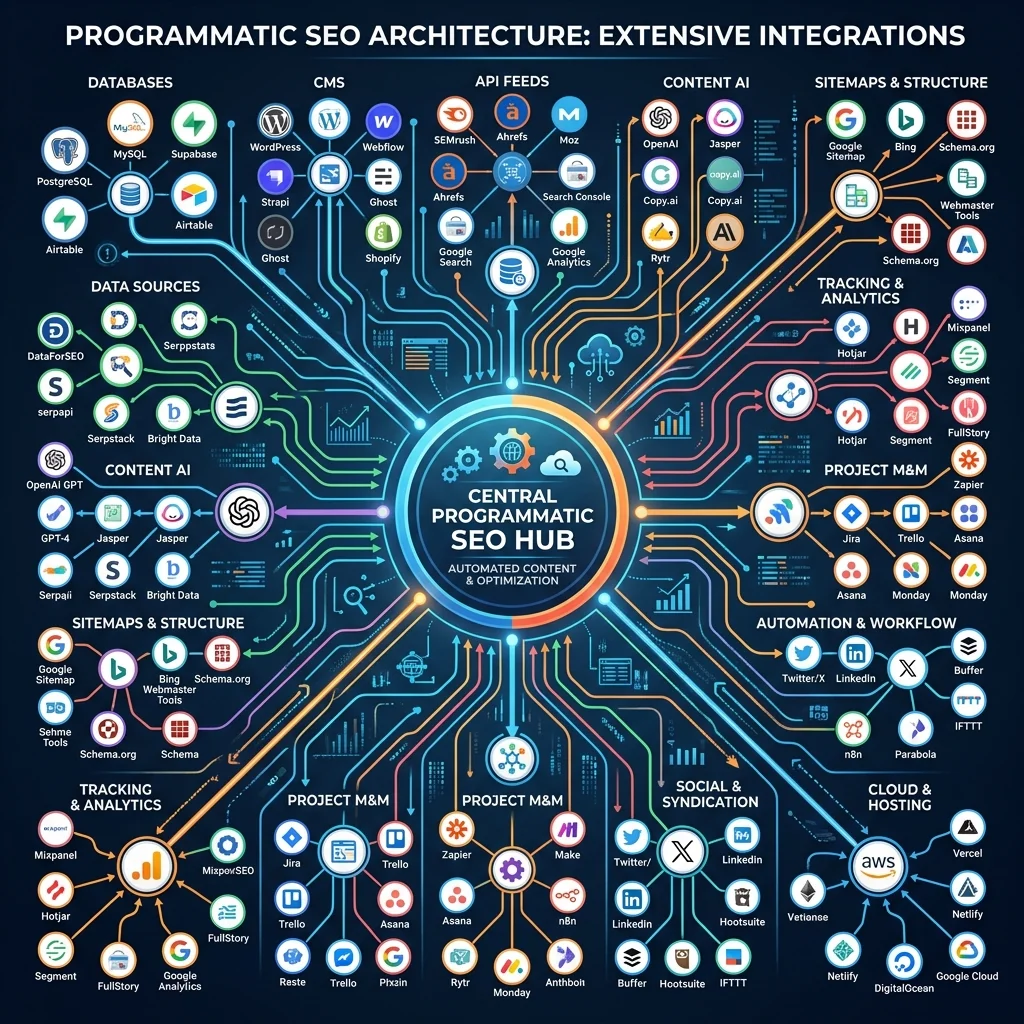
Integration pages are highly lucrative. Users searching for "Connect Tool A with Tool B" have exceptionally high intent. Instead of writing these pages manually, use your database to programmatically generate landing pages for every single integration your software supports.
For example, if you build an email marketing SaaS, you should programmatically generate pages for:
- "YourSaaS + Shopify Integration"
- "YourSaaS + WordPress Integration"
- "YourSaaS + Salesforce Integration"
Each page should dynamically pull data explaining the benefits of the connection, how to set it up, and the specific data points synced.
Expert Insight: Programmatic SEO allows a small team in Dhaka to generate thousands of highly relevant, search-optimized pages that capture long-tail traffic, mimicking the output of a massive marketing department.
Competitor Comparison Pages (The "Vs" Strategy)
Your potential customers are actively comparing you against the giants. They are searching for "HubSpot alternatives" or "YourSaaS vs Salesforce." You must own this narrative.
Create dedicated comparison pages that objectively analyze the differences. Do not just bash the competitor. Be honest about where they win, but highlight the specific areas where your Bangladeshi-built SaaS is superior. Perhaps your software is more agile, offers better customer support in their timezone, or provides a more cost-effective pricing model. By ranking for these Bottom of Funnel (BoFu) terms, you intercept buyers right before they make a purchasing decision.
Free Tools and Template Galleries
Engineering-as-Marketing is incredibly powerful for SaaS SEO. Build free, lightweight versions of your core features and host them on your domain. If you sell SEO software, build a free meta tag generator. If you sell HR software, create a free employee onboarding checklist generator. These tools attract massive amounts of backlinks and top-of-funnel traffic, which you can then nurture into paid users.
Building SaaS Content Pillars and Topic Clusters
Content marketing for SaaS is not about random acts of blogging. It requires a systematic approach based on the "Jobs to be Done" framework. What is the user actually trying to achieve when they use your software?
Prioritizing Bottom of Funnel (BoFu) Content
Many companies make the mistake of starting with Top of Funnel (ToFu) content. They write broad articles like "What is Marketing?" because the search volume is high. However, this traffic rarely converts.
Bangladeshi SaaS companies should start at the bottom of the funnel. Write content for people who already know they need a solution and are actively looking to buy. Focus on keywords with high purchase intent:
- Category keywords: "Best inventory management software for retail"
- Pain point keywords: "How to automate payroll processing"
- Feature keywords: "Software with drag and drop workflow builder"
Once you have saturated the BoFu keywords, you can slowly work your way up the funnel.
The Topic Cluster Model
Organize your content into clusters. Choose a core topic relevant to your product (e.g., "Customer Retention"). Create a comprehensive, massive "Pillar Page" that covers this topic broadly. Then, write dozens of specific "Cluster Pages" that dive deep into subtopics (e.g., "Churn Rate Calculation," "Customer Onboarding Strategies").
Link all the cluster pages back to the pillar page, and link the pillar page out to the clusters. This internal linking architecture signals to Google that you are a topical authority on the subject, boosting the rankings of all pages within the cluster.
Data-Driven Original Research
To stand out globally, you must produce content that cannot be easily replicated by AI or cheap outsourced writers. The best way to do this is by leveraging your own data. Analyze anonymized usage data from your SaaS platform to publish industry reports.
For example, "The State of E-commerce Fulfillment 2026 based on 10,000 Retailers." Original research is an absolute magnet for high-quality backlinks from major publications, which will elevate the domain authority of your entire website.
Off-Page SEO and Digital PR for SaaS Authority
Having a technically perfect site and great content is the baseline. To beat the US and EU incumbents, you need authoritative backlinks. However, traditional link-building tactics like spammy outreach do not work well for B2B SaaS.
Leveraging Software Review Platforms
Profiles on G2, Capterra, SoftwareAdvice, and Trustpilot are vital for SaaS SEO. These domains have massive authority and rank at the top for almost all "best [category] software" queries. Ensuring your profile is complete, optimized, and filled with genuine, positive reviews will not only drive referral traffic but also send strong brand signals to Google.
Strategic Digital PR
Digital PR involves creating newsworthy content and pitching it to journalists and industry bloggers. For a Bangladeshi company, your unique perspective is an asset. Pitch stories about how a startup in Dhaka is disrupting a specific global software niche. Share your original data reports with industry publications. When authoritative sites write about your company and link back to you, your search rankings will surge.
Strategic Partnerships and Integrations
Every time you build an integration with another software tool, you have an opportunity for a backlink. Reach out to the partner company and ask to be listed in their integration directory. Suggest co-authoring a blog post or hosting a joint webinar. These B2B partnerships yield highly relevant, authoritative links that competitors cannot easily replicate.
The Link Building Mindset
For SaaS, do not think about "building links." Think about building relationships, producing undeniable value, and positioning your brand where your target audience already spends their time online. The links will follow naturally as a byproduct of exceptional marketing.
Measuring SaaS SEO Success
Traffic is a vanity metric. If your organic traffic doubles but your revenue remains flat, your SEO strategy has failed. Bangladeshi SaaS companies must focus on metrics that align with business growth.
Beyond Rankings and Traffic
You need to set up rigorous tracking using Google Analytics 4 (GA4), Google Search Console, and your CRM (like HubSpot or Salesforce). The metrics you must track include:
- Marketing Qualified Leads (MQLs): How many organic visitors downloaded a whitepaper or signed up for a newsletter?
- Sales Qualified Leads (SQLs): How many organic visitors requested a demo or contacted sales?
- Free Trial Signups: The ultimate metric for product-led growth.
- Customer Acquisition Cost (CAC): SEO should drive your blended CAC down over time.
- Organic Monthly Recurring Revenue (MRR): Tracking the actual revenue generated by customers who first found you via organic search.
By tracking pipeline revenue rather than just keyword rankings, you can accurately calculate the Return on Investment (ROI) of your SEO efforts and justify further investment in organic growth.
Conclusion
Scaling a SaaS company from Bangladesh to the global stage is a formidable challenge, but it is entirely possible. By shifting away from short-term outbound tactics and committing to a long-term, product-led SaaS SEO strategy, you can build a sustainable growth engine. Focus on technical excellence, solve real user problems through targeted BoFu content, leverage programmatic pages, and build genuine digital authority. The global market is searching for the solutions you are building; it is time to make sure they find you.
Frequently Asked Questions (FAQ)
1. How long does it take to see results from a SaaS SEO strategy?
Answer: For a new domain, it typically takes 6 to 9 months to see significant organic traction. For established domains implementing a new strategy, noticeable improvements can occur in 3 to 6 months. SaaS SEO is a compounding investment. The work you do in the first six months will continue to generate leads for years, unlike paid advertising which stops the moment you turn off the budget.
2. Can a Bangladeshi SaaS company realistically outrank US competitors?
Answer: Yes, absolutely. You outrank them by changing the battlefield. Do not target the exact same broad keywords they dominate. Instead, focus on ultra-specific long-tail keywords, specific use cases, and niche integration pages. You win through superior content depth, faster technical performance, and highly targeted programmatic SEO that larger, slower competitors overlook.
3. What is the difference between B2B SaaS SEO and normal e-commerce SEO?
Answer: E-commerce SEO is heavily focused on category and product pages, dealing with physical goods and immediate transactions. B2B SaaS SEO deals with a much longer sales cycle, multiple decision-makers, and intangible products. SaaS SEO requires creating educational content, comparison guides, and detailed feature pages to nurture leads over weeks or months before a purchase decision is made.
4. Should we focus on a blog or feature pages first?
Answer: You must prioritize your core feature pages, use case pages, and pricing page first. These are the pages that actually convert visitors into customers. Once your foundational site architecture is solid and optimized for bottom-of-funnel intent, you can then invest heavily in a blog to drive top-of-funnel awareness and build topical authority through cluster content.
5. How important is website speed for global SaaS users?
Answer: It is critically important. A slow website signals poor engineering, which destroys trust in your software before they even try it. Furthermore, Google uses Core Web Vitals as a ranking factor. If your site is hosted in Bangladesh but targets users in the US, you must use a global CDN, edge caching, and optimized code to ensure sub-second load times worldwide.
6. Are backlinks still necessary for SaaS SEO in 2026?
Answer: Yes, backlinks remain a foundational signal of authority to search engines. However, the quality of links matters far more than quantity. A few highly relevant links from reputable tech blogs, software directories, and integration partners will move the needle much more than hundreds of low-quality, spammy links which can actually result in severe algorithmic penalties.
7. How do we measure the ROI of our SaaS SEO efforts?
Answer: Do not measure ROI purely by traffic or keyword rankings. You must connect your SEO analytics to your CRM. Track the number of Marketing Qualified Leads (MQLs), demo requests, and free trial signups that originate from organic search. Ultimately, calculate the organic Customer Acquisition Cost (CAC) and compare it against the Monthly Recurring Revenue (MRR) generated by those organic cohorts.
আপনার ব্যবসার জন্য প্রয়োজনীয় এসইও সেবাসমূহ:
আপনার ওয়েবসাইটকে সার্চ ইঞ্জিনের শীর্ষে নিয়ে আসতে আমাদের পেশাদার এসইও সার্ভিস (SEO Service), লোকাল এসইও (Local SEO), অন-পেজ এসইও (On-Page SEO) এবং অফ-পেজ ব্যাকলিংক সেবা গ্রহণ করুন। আজই আপনার ওয়েবসাইটের ফ্রি এসইও অডিট (Free SEO Audit) নিয়ে টেকনিক্যাল সমস্যাগুলো সমাধান করুন।
Pass It On
Found this guide helpful? Share it with fellow marketers and entrepreneurs.

Stop Letting Competitors Steal Your Organic Rankings
Get a comprehensive, search-performance blueprint detailing keyword gaps, indexing roadblocks, and custom organic strategies tailored for your business.
🔒 100% White-Hat Strategies • No Credit Card Required
Recommended Reading
View All Posts →
হোয়াটসঅ্যাপ মার্কেটিং: সরাসরি কাস্টমার পাওয়ার কৌশল (২০২৬)
বাংলাদেশের ছোট ও মাঝারি ব্যবসার জন্য হোয়াটসঅ্যাপ মার্কেটিং গাইড, অটোমেশন এবং সরাসরি সেলস বাড়ানোর উপায়।
বাংলাদেশের ই-কমার্স ওয়েবসাইটের জন্য কমপ্লিট এসইও চেকলিস্ট
বাংলাদেশের ই-কমার্স সাইটের জন্য এসইও চেকলিস্ট, লোকাল ভাষার কিওয়ার্ড টার্গেটিং এবং অর্গানিক সেলস বৃদ্ধির কমপ্লিট গাইড।

Keyword Research for Unique SaaS Products in the AI Era
How to find high-converting keywords for unique SaaS products with zero search volume by targeting problem-aware and pain-point queries.