
Keyword Research for Unique SaaS Products in the AI Era
How to find high-converting keywords for unique SaaS products with zero search volume by targeting problem-aware and pain-point queries.

The landscape of Search Engine Optimization is changing rapidly, especially for Software as a Service companies. If you are building a unique SaaS product, you have likely encountered a frustrating paradox. You know your product solves a massive problem. You know there is a large addressable market. However, when you open your favorite SEO tool to conduct keyword research, the search volume for your direct solution is practically non-existent.
This is the reality for innovators in the B2B tech space. Traditional keyword research relies heavily on historical data and established software categories. If you are creating a completely new category or offering a highly specialized solution, the historical data simply does not exist yet. Potential customers cannot search for a solution they do not even know exists.
In the era of Artificial Intelligence and Generative Search Experiences, the approach to SaaS SEO must fundamentally evolve. We can no longer rely solely on high-volume, generic terms that attract unqualified traffic. Instead, we must pivot our entire strategy toward problem-aware and pain-point queries. This comprehensive guide will walk you through the exact strategies to find high-converting keywords for unique SaaS products, even when the mainstream search volume tools report zero monthly searches.
The "Zero Volume" Trap for Innovative SaaS Products
[!TIP] আপনার ব্যবসার প্রচার ও গ্রোথ বাড়াতে SaaS অর্গানিক গ্রোথ স্ট্র্যাটেজি পেজটি দেখতে পারেন।
One of the most significant hurdles for marketing a novel SaaS tool is overcoming the illusion of zero volume. Because SEO tools rely on historical scraping, they are inherently backward-looking. They tell you what people searched for last year, not what they need today.
Consider a very specific, real-world scenario. Imagine a company developing a highly advanced WordPress plugin designed specifically for custom block layouts. The engineering team has built a revolutionary tool that replaces bloated page builders. When the marketing team begins their SEO research, they naturally look up the phrase "wordpress blocks plugins" to see how much traffic they can capture.
The result? The tools show an abysmal search volume of perhaps 50 searches per month.
For many traditional marketers, a volume of 50 indicates that there is simply no market demand. They might abandon the keyword entirely or pivot to a different, broader niche. However, this is a massive miscalculation. The reality is that some WordPress plugins in this exact niche boast hundreds of thousands of active users, both free and paid.
So, if the search volume for the direct product description is only 50, where are these hundreds of thousands of users coming from?
The answer is that they are not searching for the product category. They are searching for the problems they are trying to solve. They are typing out broader, pain-point queries that reflect their immediate frustrations.
Instead of searching for the tool itself, they search for the outcome they desire or the obstacle they are facing. They type things like: "how to design a custom wordpress homepage without coding" "why is my wordpress site so slow with page builders" "best way to align images and text in wordpress effortlessly"
These problem-centric queries have significantly higher volume than the product-centric query. More importantly, they represent users actively struggling with a problem your product is perfectly positioned to solve. If your content can intersect with their search at the exact moment of their frustration, you have discovered a high-converting keyword strategy that your competitors are likely ignoring.

Shifting the Paradigm
To master keyword research for unique SaaS products, you must deeply understand the stages of customer awareness, a concept originally popularized in classic copywriting but highly applicable to modern SEO.
The traditional SEO playbook often focuses heavily on solution-aware or product-aware users. These are people who know exactly what they need. They search for terms like "best CRM software," "alternative to Salesforce," or "cheapest email marketing tool." The intent is clear, but the competition is incredibly fierce.
But what if your product does not fit neatly into an existing category? What if it is a completely new way to manage customer relationships through asynchronous video messaging? Almost no one is going to search for "asynchronous video CRM" because the category has not been established in the public consciousness.
This is precisely where you must target the problem-aware stage. At this stage, the prospect knows they have a problem, but they do not know a dedicated software solution exists. Their search queries directly reflect their symptoms.
Pain points drive higher conversions for unique SaaS products because they offer you the unique opportunity to educate the market from the ground up. When you capture a user on a problem-aware query, you become the trusted advisor. You get to define the parameters of the ideal solution. By the time they are ready to make a purchase decision, they are not comparing you to legacy competitors because you have strategically positioned your unique product as the only logical answer to their highly specific pain.
Strategies for Finding Pain-Point Queries
If traditional SEO tools are failing to provide accurate volume data for your innovative product, where do you find these elusive pain-point keywords? The answer lies in stepping outside of standard SEO software and listening directly to the market.
1. Listen to Sales Calls and Customer Support Tickets
Your sales and customer support teams are sitting on a massive, untapped goldmine of SEO data. When a prospect books a demo, what is the very first problem they mention? When a user submits a support ticket, what exact language do they use to describe their frustration?
You must record and analyze these exact phrases. If a prospect says on a discovery call, "I am spending ten hours a week manually copying data from my email to my spreadsheet," that is your new keyword target. You do not write an article about "data integration software." You write a highly targeted article titled "How to stop manually copying email data to spreadsheets." You are matching their internal monologue word for word.
2. Analyze Competitor Gaps in Problem Solving
Do not just look at the high-volume keywords your competitors are ranking for. Look closely at the specific problems they are failing to address in their content libraries. Often, legacy SaaS companies rank well for high-volume, generic terms but completely ignore the nuanced, long-tail pain points of power users.
Read the negative reviews of your competitors on platforms like G2, TrustRadius, or Capterra. What are users constantly complaining about? Are they frustrated by clunky onboarding? Are they annoyed by a specific missing integration? Those complaints are your problem-aware keywords. Write content that directly addresses those shortcomings.
3. Utilize AI and Natural Language Processing for Topic Clustering
In the modern AI era, we can leverage large language models to brainstorm symptom-based queries at scale. You can prompt an AI to generate a list of daily frustrations experienced by your exact target demographic. This exercise can uncover tangential problems that your software might solve, allowing you to cast a much wider net for organic traffic.
- Mine sales transcripts for the exact phrasing of customer frustrations.
- Analyze negative competitor reviews to find unsolved industry problems.
- Target the specific "symptoms" of the problem rather than the name of the cure.
- Use AI tools to brainstorm natural language questions your ideal persona frequently asks.
Navigating the AI Search Era (SGE and Beyond)
The introduction of AI-powered search engines and generative answering systems, such as Google Search Generative Experience, ChatGPT, and Perplexity, has fundamentally altered how users seek out B2B information.
In the past, users would type fragmented, keyword-stuffed queries like "wordpress blocks plugins fast." Today, they type full, conversational, highly detailed questions like "What is the best way to speed up a WordPress site that uses too many heavy page builder plugins?"
This dramatic shift to conversational search makes long-tail, problem-aware keywords even more critical to your success. AI search engines are specifically designed to understand intent and contextual nuance. If your article directly and comprehensively answers a complex, nuanced question, an AI search engine is significantly more likely to feature your content in its generated summary at the top of the page.
Furthermore, the concept of E-E-A-T (Experience, Expertise, Authoritativeness, and Trustworthiness) is absolutely paramount in B2B SaaS. AI search engines prioritize content written by recognized experts who demonstrate deep industry knowledge. When you write about deep, specific pain points rather than superficial, high-volume keywords, you naturally demonstrate your expertise. You show both the search engine algorithms and the human reader that you truly understand the complexities of the industry.

A Step-by-Step Guide to Zero-Volume SaaS Keyword Research
To systematize this problem-aware approach, you can follow this five-step framework for uncovering and targeting high-value, zero-volume keywords for your unique product.
Step 1
Start by articulating the exact, visceral pain your software alleviates. Do not describe the technical features. Describe the bleeding neck problem that keeps your buyer awake at night. For instance, do not say "We provide automated workflow routing." Say, "We stop customer success teams from losing critical client requests in messy Slack channels."
Step 2
If the core problem is "losing client requests in Slack," what are the daily symptoms? The symptoms are what the user actually experiences and complains about day-to-day. Symptoms might include "missed client deadlines," "client churning due to slow response times," or "how to organize slack channels for client management."
Step 3
Translate those specific symptoms into the exact phrases a user would type into a search bar. Use forums like Reddit, Quora, and specialized Slack or Discord industry communities to see how real people phrase these questions. Examples of mapped queries: "How to prevent critical messages from getting lost in Slack" "Best Slack setup for managing multiple high-ticket clients"
Step 4
When you plug these long-tail phrases into an SEO tool, they might show absolute zero volume. Do not panic and do not discard them. Instead, look at the actual search engine results page for that query. Are people asking this exact question in forums? Are there outdated blog posts clumsily trying to answer it? If there is evidence of the problem existing in the real world, the search intent is validated. In B2B SaaS, a keyword with 10 highly qualified, desperate searches a month is infinitely more valuable than a generic keyword with 10,000 unqualified, browsing searches.
Step 5
Create comprehensive, authoritative content that directly addresses the pain point head-on. Do not immediately pitch your product in the first paragraph. First, validate their frustration. Let them know they are not alone. Second, explain precisely why traditional solutions or workarounds fail to fix the root cause. Finally, introduce your unique SaaS product as the logical, purpose-built solution designed specifically to eliminate this exact pain point.
Structuring Content for AI Summaries and Human Readers
In the AI search era, how you structure your content is just as important as the keywords you choose to target. AI models parse information based on structural elements, hierarchy, and clarity of thought. To maximize your chances of being cited by an AI search summary while simultaneously keeping human readers deeply engaged, you must format your posts meticulously.
Use highly descriptive, question-based H2 and H3 tags. Instead of a vague heading that simply says "The Solution," use a precise heading like "How to Solve High Churn Rates Caused by Poor Onboarding."
Use bulleted lists and numbered steps frequently. AI language models love to extract well-formatted lists to provide quick, digestible answers to users. If your content is dense paragraphs of text, it is much harder for an AI to parse and feature your insights.
Moreover, clearly define terms and concepts throughout your writing. If you are introducing a new framework or a unique approach to a legacy problem, explicitly state what it is in a clear, concise sentence right at the beginning of the section. This structured clarity dramatically increases the likelihood that an AI will use your specific definition as the authoritative source on the topic.
Case Study
Let us return to the WordPress blocks plugin example to see this strategy in action. The direct keyword "wordpress blocks plugins" has 50 monthly searches. The developer knows their product is technically superior and much faster than the bloated, legacy page builders dominating the market.
Instead of fighting a losing battle for that specific low-volume keyword, they implement a comprehensive problem-aware strategy. They identify that their ideal power users are incredibly frustrated with slow website loading speeds, which are often caused directly by those traditional page builders.
They decide to target the long-tail query: "why is my page builder so slow and how to fix it."
While the direct product keyword had no volume, this problem-centric query has significant search volume. It is highly specific. More importantly, it indicates a severe, immediate pain point. The user is actively seeking a fix for a problem that is likely costing them money or traffic.
The resulting content strategy is elegant. They write an in-depth, highly technical article analyzing the code bloat of traditional page builders. They explain the exact technical reasons behind the slow speeds. Then, they introduce the concept of native WordPress blocks as the lightweight, modern alternative. Finally, they introduce their unique block plugin as the ultimate tool to achieve page-builder-like designs without any of the performance penalties.
By targeting the pain point (slow website speed) and the competitor frustration (bloated builders), they capture a massive, highly motivated audience that would never have searched for "wordpress blocks plugins" directly. They intercept the user at the height of their frustration and offer the perfect, high-performance cure.
Conclusion
The era of matching high-volume, generic keywords to equally generic landing pages is officially over for innovative B2B companies. As artificial intelligence continues to refine exactly how search engines understand user intent, the massive advantage goes directly to the SaaS companies that deeply understand their customers' daily struggles.
Keyword research for unique SaaS products is no longer about finding the highest number in a spreadsheet. It is about empathy. It is about actively listening to the market, identifying the exact friction points in their workflows, and writing highly authoritative content that guides the user from a state of frustration to a state of resolution. Embrace the zero-volume keywords, target the real pain points, and watch your high-intent traffic grow consistently over time.
Frequently Asked Questions
Unique SaaS products often create entirely new categories or solve legacy problems in highly novel ways. Traditional keyword research tools rely entirely on historical search data for established terms and categories. Because your specific solution is brand new to the market, people do not know it exists, and therefore, they do not search for it by name. This dynamic results in SEO tools reporting zero or very low search volume for your most accurate and descriptive keywords.
A problem-aware keyword is a specific search query used by someone who knows they have a pressing issue but does not yet know what solutions or software categories are available. Instead of searching for a product category like "inventory management software," they search directly for their symptom. Examples include queries like "how to stop running out of stock during busy season" or "why are spreadsheet errors causing inventory loss."
You can successfully validate a zero-volume keyword by looking outside of traditional SEO software. Check if the exact question is being asked on community platforms like Reddit, Quora, or industry-specific Slack groups. Look closely at the Search Engine Results Page (SERP) to see if Google is attempting to answer the query with related forum threads or outdated, poorly written articles. If you hear the exact phrase used on sales discovery calls or in customer support tickets, the search intent is fully validated regardless of what the volume estimation tools say.
AI search engines and generative models are rapidly shifting the focus away from simple keyword matching to understanding deep user intent and natural language processing. Users are now typing longer, much more conversational questions. AI tools then summarize the best, most comprehensive answers directly in the search results. To rank well in this new environment, SaaS companies must pivot to providing highly structured, authoritative, and direct answers to complex pain-point queries.
No, you should not ignore them entirely, but they should absolutely not be your primary focus if you offer a unique, specialized solution. High-volume keywords can be somewhat useful for top-of-funnel brand awareness over the long term. However, the conversion rate on broad, high-volume terms is typically very low because the intent is fractured. Your highest converting traffic, and ultimately your most valuable leads, will come from specific, long-tail, problem-aware queries, even if their monthly search volume is technically much lower.
The secret to a high-converting transition is mapping it out logically without being overly promotional too early. First, deeply validate their problem and show genuine empathy for their situation. Next, clearly explain why the solutions they have tried so far (the industry status quo) are failing them on a technical or strategic level. Then, introduce the mandatory criteria for a perfect solution. Finally, introduce your unique SaaS product as the precise tool that was specifically built from the ground up to meet those exact criteria and permanently solve their unique pain point.
The absolute best place to find pain-point keywords is directly from the mouths of your customers and prospects. You must regularly review transcripts from sales discovery calls, read through detailed customer support tickets, and carefully analyze user onboarding feedback. Pay very close attention to the exact adjectives and verbs they use when describing their daily frustrations. Additionally, systematically mining the negative reviews of your competitor products on review sites can reveal major gaps in the market that your targeted content can perfectly address.
আপনার ব্যবসার জন্য প্রয়োজনীয় এসইও সেবাসমূহ:
আপনার ওয়েবসাইটকে সার্চ ইঞ্জিনের শীর্ষে নিয়ে আসতে আমাদের পেশাদার এসইও সার্ভিস (SEO Service), লোকাল এসইও (Local SEO), অন-পেজ এসইও (On-Page SEO) এবং অফ-পেজ ব্যাকলিংক সেবা গ্রহণ করুন। আজই আপনার ওয়েবসাইটের ফ্রি এসইও অডিট (Free SEO Audit) নিয়ে টেকনিক্যাল সমস্যাগুলো সমাধান করুন।
Pass It On
Found this guide helpful? Share it with fellow marketers and entrepreneurs.

Stop Letting Competitors Steal Your Organic Rankings
Get a comprehensive, search-performance blueprint detailing keyword gaps, indexing roadblocks, and custom organic strategies tailored for your business.
🔒 100% White-Hat Strategies • No Credit Card Required
Recommended Reading
View All Posts →
SaaS SEO Strategy for Bangladeshi Software Companies (2026 Guide)
A complete SaaS SEO strategy for Bangladeshi software companies to scale globally, acquire B2B leads, and reduce customer acquisition costs.

হোয়াটসঅ্যাপ মার্কেটিং: সরাসরি কাস্টমার পাওয়ার কৌশল (২০২৬)
বাংলাদেশের ছোট ও মাঝারি ব্যবসার জন্য হোয়াটসঅ্যাপ মার্কেটিং গাইড, অটোমেশন এবং সরাসরি সেলস বাড়ানোর উপায়।
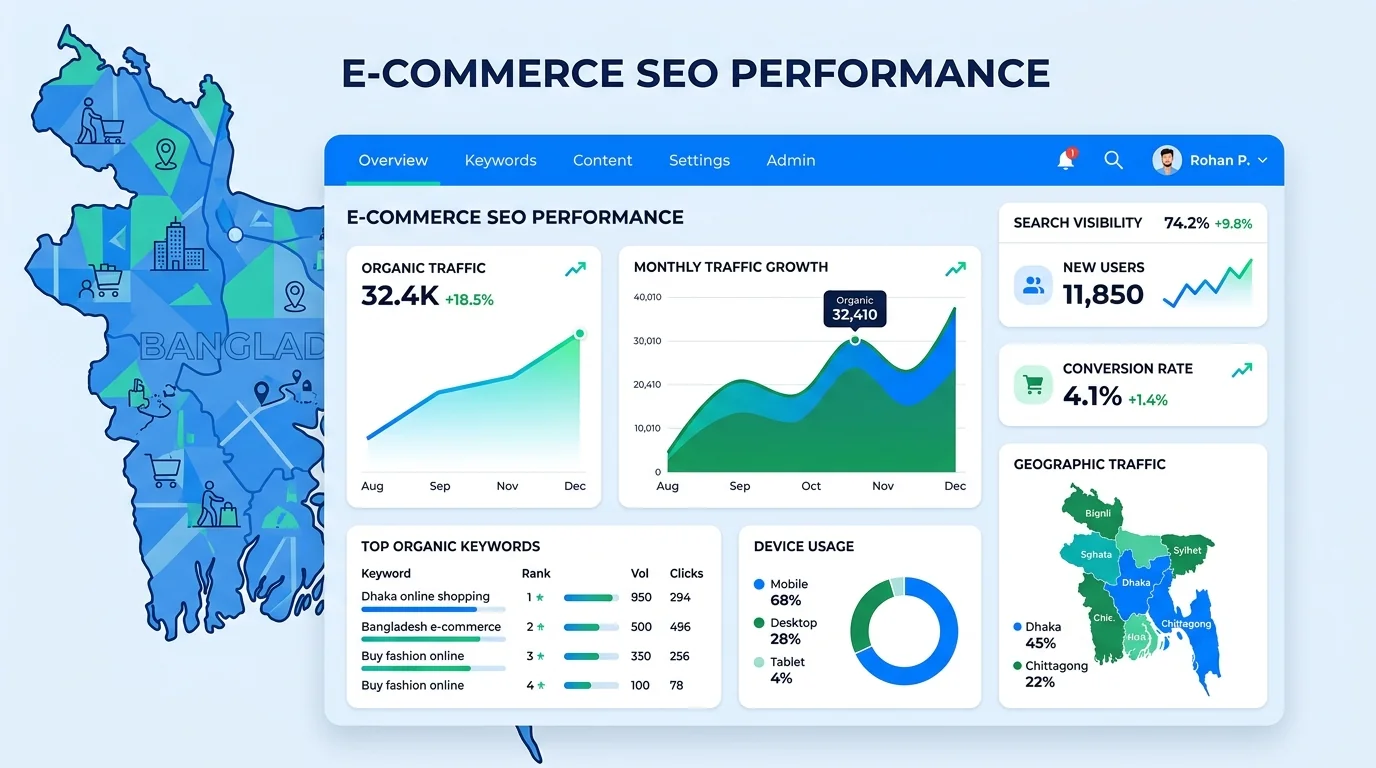
বাংলাদেশের ই-কমার্স ওয়েবসাইটের জন্য কমপ্লিট এসইও চেকলিস্ট
বাংলাদেশের ই-কমার্স সাইটের জন্য এসইও চেকলিস্ট, লোকাল ভাষার কিওয়ার্ড টার্গেটিং এবং অর্গানিক সেলস বৃদ্ধির কমপ্লিট গাইড।