
113% App Install Growth via B2B Fintech SEO Strategy
Client: Confidential Fintech App
Industry: B2B Payments & Financial Technology
Location: PAN India
Agency: আমাদের প্রফেশনাল এসইও সেবা
1. Introduction
The financial technology sector is experiencing unprecedented growth, yet acquiring high-quality B2B users organically remains one of the most difficult challenges for new platforms. Unlike consumer-facing applications that can rely on viral marketing or broad search terms, B2B fintech solutions target a very specific demographic: business owners, financial controllers, and procurement managers. These decision-makers are risk-averse, highly analytical, and require substantial education before adopting a new financial tool.
Our client, a disruptive B2B fintech platform, faced exactly this dilemma. Their innovative application allowed businesses to leverage existing credit cards to pay for operational expenses such as rent, vendor invoices, utilities, and taxes. This solution effectively transformed unused credit lines into vital working capital, maximizing cash flow without the need for traditional business loans. Despite the immense value proposition, their app struggled to gain traction in organic search results. The digital ecosystem for financial services is heavily guarded by legacy banks and massive financial institutions, making it exceptionally difficult for a startup to break through the noise and drive meaningful app installs.
To overcome these hurdles, the client partnered with SEO Services Bangladesh. Our mandate was clear: build a robust organic growth engine that not only attracted the right B2B audience but also converted that traffic into verified app installs, all while navigating the stringent regulatory and algorithmic requirements of the modern search landscape.

2. Identifying the Core Growth Blockers
Before implementing any strategic changes, our team conducted a comprehensive audit of the client's digital footprint. We identified several critical bottlenecks that were suffocating their organic visibility and preventing app installations.
A. The YMYL and E-E-A-T Deficit
Because the client operates in the financial sector, their website falls strictly under Google's "Your Money or Your Life" (YMYL) category. Pages that can impact a user's financial stability are scrutinized heavily by search algorithms. The client's existing website lacked essential E-E-A-T (Experience, Expertise, Authoritativeness, and Trustworthiness) signals. There were no clear author biographies for financial content, regulatory compliance information was buried, and third-party trust badges were absent. Without these signals, Google was hesitant to rank their pages for high-intent financial queries.
B. The Challenge of Trust Signals for App Installs
Asking a business to process thousands of dollars through an unfamiliar app requires a massive leap of faith. The client's landing pages lacked critical trust signals required for conversion. While the technology was secure, the website did not prominently display security protocols like PCI-DSS compliance, end-to-end encryption standards, or verified customer testimonials. This friction point was causing visitors to bounce before clicking the download app button.
C. Diluted Search Intent and B2C Cannibalization
A significant portion of the client's existing traffic was coming from broad keywords like "credit card bill payment" or "pay rent with credit card." While these terms have high search volume, they are predominantly driven by B2C consumers looking to pay personal bills. This misalignment resulted in a high bounce rate and virtually zero B2B app installs. The content architecture failed to differentiate between consumer finance and enterprise working capital solutions.
D. Complex B2B Decision-Making Cycles
Unlike a consumer downloading a free game, adopting a B2B payment platform involves multiple stakeholders. A founder might discover the app, but the CFO and compliance officer must approve it. The existing content strategy only targeted the initial discovery phase, offering no deep-dive resources, security whitepapers, or integration guides needed to facilitate a complex enterprise decision.
- Strict YMYL algorithmic filters suppressing existing content.
- Insufficient trust signals resulting in high page abandonment.
- B2C traffic cannibalizing B2B conversion funnels.
- Lack of middle and bottom-of-funnel content for multi-stakeholder decisions.
3. Our Comprehensive SEO and App Growth Strategy
To resolve these challenges and drive a surge in app installs, SEO Services Bangladesh developed a multi-phased strategy tailored specifically for the B2B fintech ecosystem.
Phase 1
Our first priority was signaling to both search engines and potential users that this platform was a secure, authoritative financial institution.
We completely overhauled the "About Us" and "Security" sections of the website. We created dedicated, schema-enriched author profiles for the company's leadership and content creators, highlighting their credentials in the financial sector. We implemented strict editorial guidelines, ensuring every piece of content was reviewed by a financial expert before publication.
To address the user trust gap, we placed security badges, SSL certificates, and PCI compliance logos prominently near every app download call-to-action. We also integrated verified case studies and testimonials from existing B2B clients, demonstrating social proof and reducing the perceived risk of downloading the app.

Phase 2
A seamless technical foundation is non-negotiable for fintech SEO. We resolved crawlability issues by restructuring the site hierarchy to logically group topics around core features, such as "Vendor Payments," "Utility Bills," and "Tax Payments."
Crucially, we implemented advanced structured data. We utilized FinancialProduct, SoftwareApplication, and Organization schema to help search engines understand the exact nature of the business and its offerings.
To bridge the gap between web traffic and app installs, we optimized the mobile web experience. We introduced non-intrusive, context-aware smart banners that directed mobile web users directly to the Apple App Store or Google Play Store. Deep linking was implemented so that users reading a specific article were dropped directly into the corresponding feature screen within the app after installation.
Phase 3
We moved entirely away from high-volume, low-intent consumer keywords. Instead, we focused on long-tail, highly specific B2B queries. While the search volume was lower, the conversion rate for these terms was exponentially higher.
We mapped the content funnel to the B2B buyer journey:
- Top of Funnel (Awareness): We created educational content addressing cash flow bottlenecks. Topics included "How SMEs Can Optimize Working Capital Without Bank Loans" and "Managing Vendor Relationships During Cash Crunches."
- Middle of Funnel (Consideration): We built comparative guides that positioned the app against traditional alternatives. Articles like "Business Credit Cards vs. Short-Term Business Loans" educated users on the benefits of leveraging existing credit lines.
- Bottom of Funnel (Decision): We developed highly specific feature pages such as "How to Pay Commercial Rent Using a Corporate Credit Card." These pages were heavily optimized for conversions, featuring clear step-by-step instructions and prominent app download buttons.
Phase 4
Traffic without conversion is merely a vanity metric. We deployed rigorous A/B testing on all major landing pages. By analyzing heatmaps and user session recordings, we identified exactly where users were dropping off.
We refined our calls-to-action. Instead of generic "Download Now" buttons, we used value-driven prompts such as "Unlock Working Capital Today" or "Start Paying Vendors via Credit." We also streamlined the information architecture so that the journey from an informational blog post to the app store listing was completely frictionless.
4. Implementation Timeline
Executing a campaign of this magnitude required meticulous planning and phased deployment. Here is how we rolled out the strategy over the first six months:
Month 1: Technical Foundation and Audit During the first month, our focus was entirely on diagnostics and structural repair. We conducted a deep crawl of the existing website to identify broken links, slow-loading pages, and indexing errors. We implemented the initial schema markup and restructured the URL hierarchy to better reflect the B2B payment clusters.
Month 2: E-E-A-T and Trust Optimization Month two was dedicated to establishing authority. We launched the new author biographies, overhauled the security compliance pages, and integrated third-party review widgets. We worked closely with the client's legal and compliance teams to ensure all website copy met regulatory standards while remaining engaging for the user.
Month 3: Content Engine Activation With the foundation set, we began publishing our intent-driven content. We rolled out the first batch of bottom-of-funnel feature pages, followed by middle-of-funnel comparative guides. Every piece of content was meticulously interlinked, guiding users from broader educational topics down to specific conversion endpoints.
Month 4: Mobile Optimization and App Install Routing As traffic began to scale, we shifted our focus to the transition between the web environment and the app ecosystem. We implemented smart app banners tailored to the user's operating system (iOS or Android). We refined the mobile layout to ensure lightning-fast load times and seamless navigation, recognizing that a significant portion of B2B research is conducted on mobile devices.
Month 5 and 6: Data Analysis and CRO Iteration In the final months of the initial campaign, we analyzed user behavior data meticulously. We A/B tested different variations of hero images, headline copy, and CTA placements. We refined our keyword targeting based on which queries were generating the highest-quality app installs, continuously tightening the feedback loop between SEO and user acquisition.
- Deployment of robust FinancialProduct and SoftwareApplication Schema.
- Implementation of OS-specific smart app banners for seamless routing.
- Integration of deep linking architecture for contextual app onboarding.
- Comprehensive site speed optimization focusing on Core Web Vitals.
5. Results
Within just three to six months of implementing our tailored B2B fintech strategy, the results were transformative. By aligning technical excellence with user intent and robust trust signals, we turned organic search into the client's most efficient acquisition channel.
Key Performance Indicators (KPIs) Achieved:
- App Install Growth (+113.43%): The ultimate metric of success. By targeting high-intent B2B decision-makers and reducing friction between the website and the app stores, we more than doubled organic app installations.
- Keyword Coverage (+180.35%): We drastically expanded the client's footprint across highly relevant B2B payment queries, capturing a wider array of the target audience.
- Top 5 Ranking Keywords (+178.9%): We successfully pushed critical, high-converting keywords from the second page of Google into the top 5 positions, capturing the lion's share of click-through rates.
- Non-Brand Organic Traffic (+125.38%): By educating the market and ranking for problem-aware queries, we drove a massive surge in net-new users who had never previously heard of the brand.
- Bounce Rate Reduction: By eliminating B2C consumer traffic and focusing purely on enterprise intent, user engagement metrics improved dramatically, sending positive quality signals back to search engines.

6. The Takeaway for B2B Fintech Brands
The success of this campaign provides a blueprint for other B2B financial applications struggling with organic growth. It proves that massive search volume is not a prerequisite for success. In the B2B space, relevance, authority, and trust are far more valuable than raw traffic numbers.
When dealing with YMYL topics and complex financial products, traditional SEO tactics are insufficient. Success requires a holistic approach that builds genuine credibility, educates the user, and systematically removes friction from the conversion journey. By treating your website not just as a digital brochure, but as an authoritative financial resource and a seamless bridge to your application, you can achieve exponential growth even in the most competitive sectors.
7. Frequently Asked Questions
For B2B fintech applications, meaningful SEO results typically take between 4 to 6 months to materialize. This longer timeline is due to the intense scrutiny search engines apply to financial websites (YMYL guidelines) and the time required to build sufficient domain authority and trust signals. While technical fixes can yield quick improvements in indexing, ranking for high-intent commercial queries requires a sustained commitment to producing authoritative content and earning high-quality backlinks. In this specific case study, we saw exponential growth in app installs beginning in month three, scaling rapidly thereafter.
The primary challenges include navigating Google's strict YMYL (Your Money or Your Life) quality standards, overcoming the immense domain authority of legacy financial institutions, and distinguishing B2B search intent from B2C search intent. Many financial queries are dominated by consumers looking for personal solutions. A successful strategy must hyper-target long-tail keywords that specifically indicate enterprise or SME intent, while simultaneously building an impenetrable layer of trust and security signals on the website to satisfy both algorithms and skeptical corporate decision-makers.
YMYL stands for "Your Money or Your Life." Google applies much stricter ranking criteria to pages that can impact a user's future happiness, health, financial stability, or safety. For a fintech app, this means your content must demonstrate exceptional E-E-A-T (Experience, Expertise, Authoritativeness, and Trustworthiness). If your site lacks clear authorship by financial experts, transparent corporate information, verifiable security protocols, and accurate, well-researched content, Google will actively suppress your rankings to protect users from potentially harmful financial advice or insecure platforms.
Content marketing drives app installs by capturing users at various stages of the problem-awareness cycle. In B2B fintech, users rarely search directly for a new app; they search for solutions to financial pain points, such as "how to manage vendor payments during a cash shortage." By creating authoritative content that answers these questions, you attract highly qualified traffic. By seamlessly integrating your app as the ultimate solution to that specific problem, and providing frictionless pathways to the app store (like smart banners), informational content becomes a direct acquisition channel.
Technical SEO ensures that search engines can accurately crawl, interpret, and index your complex platform. For fintech apps, this involves implementing specific structured data (like SoftwareApplication and FinancialProduct schema) to clearly define what your product does. Additionally, technical SEO encompasses site speed, mobile responsiveness, and secure architecture (HTTPS). A slow, technically flawed website not only fails to rank but also destroys user trust, which is fatal for a financial application attempting to convince users to process corporate transactions.
Trust signals serve a dual purpose: they satisfy algorithmic E-E-A-T requirements and they convert human visitors. From an SEO perspective, trust signals like detailed "About Us" pages, clear contact information, terms of service, and author bios prove to Google that you are a legitimate entity. From a user perspective, displaying PCI-DSS compliance logos, encryption standards, and verified client testimonials reduces the perceived risk of downloading a financial app. Higher trust leads to lower bounce rates and higher engagement, which in turn boosts overall search rankings.
Separating intent requires looking beyond search volume and analyzing the specific modifiers users append to their queries. B2C users might search for "pay rent with credit card" or "best credit card app." B2B users will use terms like "commercial rent payment platform," "vendor invoice credit card processing," or "SME working capital management." We filter keywords by focusing on these enterprise-specific modifiers and analyzing the current Search Engine Results Pages (SERPs) to ensure Google is serving business solutions rather than consumer blogs for those queries.
More Case Studies:
UX Optimization and SEO Increase Organic Traffic by 41%
6-Month SEO Strategy Boosts Student Leads by 430%
Healthcare SEO + SEM Strategy Drives 71% More Leads
PPC Case Study: Google Ads Success for a NZ-Based Home Service Brand
Organic Sessions Surge 270% for Online Art Platform with Tailored SEO Strategy
Ready to Achieve Similar Growth for Your Brand?
If you are a B2B Fintech Platform in Bangladesh and aspire to:
- Dominate Google search results for critical financial and B2B queries
- Drive a consistent, high volume of qualified inquiries and verified app installs
- Build unparalleled long-term online authority and institutional trust
Then partner with SEO Services Bangladesh. We are poised to transform your brand's digital visibility and enterprise value.
আপনার ব্যবসার জন্য প্রয়োজনীয় এসইও সেবাসমূহ:
আপনার ওয়েবসাইটকে সার্চ ইঞ্জিনের শীর্ষে নিয়ে আসতে আমাদের পেশাদার এসইও সার্ভিস (SEO Service), লোকাল এসইও (Local SEO), অন-পেজ এসইও (On-Page SEO) এবং অফ-পেজ ব্যাকলিংক সেবা গ্রহণ করুন। আজই আপনার ওয়েবসাইটের ফ্রি এসইও অডিট (Free SEO Audit) নিয়ে টেকনিক্যাল সমস্যাগুলো সমাধান করুন।
More Case Studies
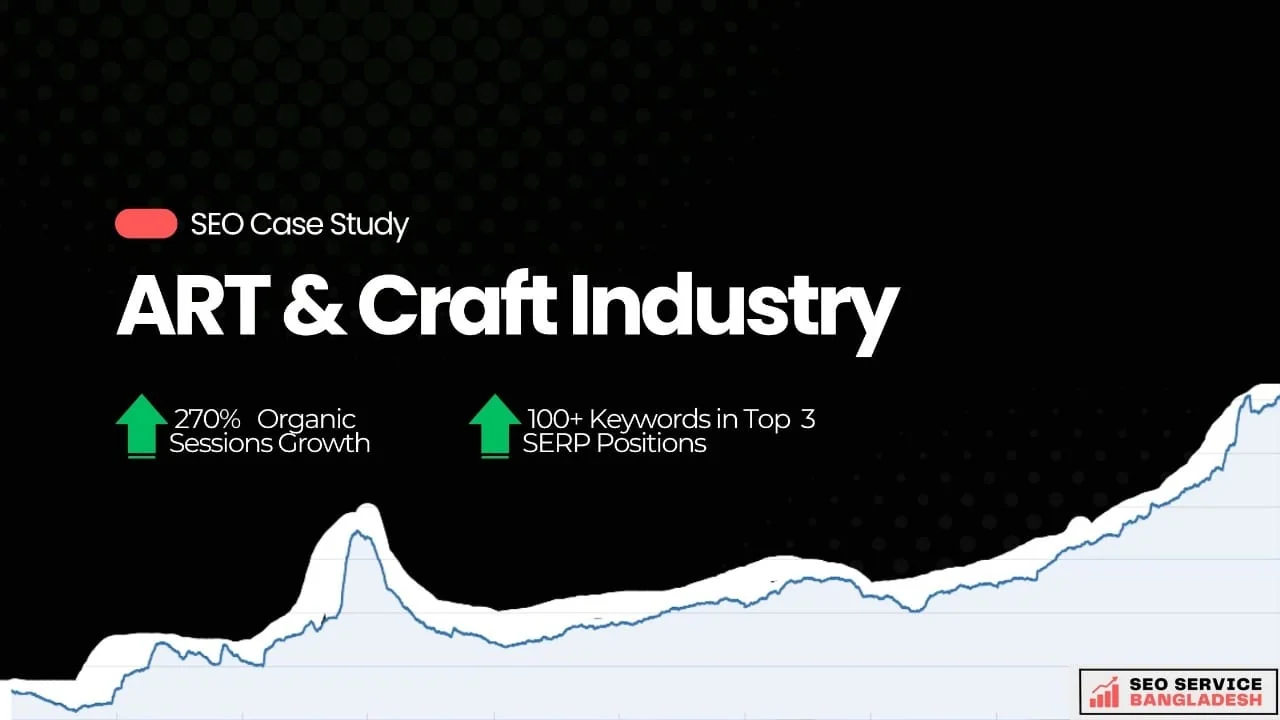
270% Increase in Organic Sessions for Art Marketplace via SEO Strategy
Read our SEO case study on how an art marketplace achieved a 270% increase in organic sessions. Learn proven strategies for e-commerce growth.
13X Organic Growth for E-Commerce SEO in 8 Months
See how we achieved 13X organic growth for an e-commerce brand in 8 months. Read the case study on technical SEO and visibility improvements.
UX অপ্টিমাইজেশন এবং এসইও কীভাবে অর্গানিক ট্রাফিক ৪১% বৃদ্ধি করে
Read our Magento SEO case study showing a 41% increase in organic traffic. Learn how UX optimization and technical fixes led to 74% more sales.